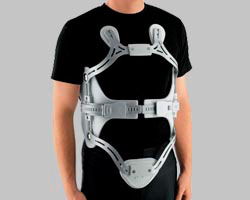


Even the smallest problems with the back can complicate a person’s life and cause a lot of discomfort and unpleasant sensations. Orthopedic corsets often come to the rescue by relieving unpleasant symptoms and providing both preventive and therapeutic effects on the musculoskeletal system. Medical corsets are actively used after complex spinal surgeries (such as herniated discs, spinal fractures, deformities). There are several important questions we would like to answer, and we hope this information will be useful to you.
How to properly wear a corset for the spine (corrective corset)?
A back corset or posture corrector is a subtype of medical corsets widely used today for the treatment and prevention of back problems, injuries, slouching, and spinal curvature.
Corsets for posture correction show excellent results. Wearing one for just a few hours a day can help combat slouching in both adults and children, as well as relieve pain and heaviness in the back.
How to properly wear a corset for a herniated disc?
If a person develops a hernia in the spinal sections, an orthopedic corset can prevent the development and progression of this condition. A corset for a herniated disc is relevant both before and after surgery. It provides good fixation and support, relieving muscle tension and eliminating pain.
To choose the most effective back corset, you need to know a few nuances. A corset for a herniated disc should fit tightly around the spinal sections and wrap around the entire back from the chest to the lower back.
A quality orthopedic corset must meet all standards and regulations. It is very important to select the correct size. The corset should not be loose, but it also should not compress too tightly. If you experience discomfort or pain while wearing the corset, remove it and consult your doctor, who can identify the problem.
How to properly wear a corset after surgery?
A corset supports the spine for several months after surgery. The main requirement for a modern corset is comfort and functionality. If the corset is uncomfortable, it causes suffering instead of relief. Rather than helping, it creates problems due to constant wearing discomfort, and some patients give up using the corset after a week of suffering, break the prescribed regimen, and thus delay their recovery. That’s why it’s important to choose a corset before the surgery (while there are no incisions or dressings, you can try on and select a suitable model from a wide range).
People often ask online how long they need to wear a corset after spinal surgery. There is no definite answer because everything depends on the individual case, the illness, and the complexity of the operation. In any case, your treating physician will tell you how and for how long you need to wear the corset after surgery. The doctor will also explain how to choose the right corset and demonstrate how to properly wear it for the spine or for an umbilical hernia. Our store offers a wide selection of corsets for every need.
Can you wear a corset 24/7?
It depends on the individual case. Most often, an orthopedic corset should be taken off for rest and during sleep.
Corset for Compression Fracture of the Spine
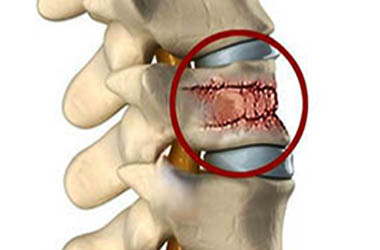
A compression fracture of the spine is a serious injury accompanied by constant back pain and the development of other spinal pathologies, such as post-traumatic osteochondrosis. Essentially, it’s a crack in a vertebra caused by excessive pressure or direct trauma. Timely medical help and treatment are crucial.
One of the main treatment methods is spinal fixation using a specialized orthopedic corset. Thanks to the corset, the bone tissue can heal and recover properly.
The corset brings the spinal column into its natural anatomical position, positively affecting the rehabilitation process. Additionally, the orthopedic corset protects the spine from disk displacement and worsening of the condition. Immediately after the injury, the patient is fitted with a rigid plaster cast. After one week, it can be replaced with a rigid fixing corset.
What does such a corset look like?
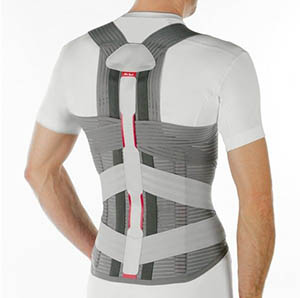
Reinforced bands made of elastic medical textiles perform the same functions as a cast but are much lighter, more mobile, and comfortable to wear.
First and foremost, it encircles and stabilizes the entire back (covering the lumbar-sacral or thoracolumbar regions). If the cervical spine was injured, the patient is also prescribed a Shantz collar along with the corset. It ensures complete neck immobilization and partially unloads it from the weight of the head.
Unlike posture correctors, the corset for a compression fracture is made from more durable materials and always includes stiffening inserts.
Metal or polyurethane stiffening ribs securely fix the spine. The degree of fixation and the number of ribs vary, and these parameters are chosen by the doctor depending on the nature of the injury. For complex fractures, plastic models are used. These provide full immobilization and can even be an alternative to a plaster cast. Rigid fixing corsets eliminate muscle hypertonicity and create conditions for normal blood circulation and tissue metabolism. They are custom-made based on individual measurements in specialized orthopedic centers.
Contraindications to Wearing Corsets
Use of this corset is not recommended in the following cases:
- Scoliotic spinal deformities less than 20 degrees in patients who have completed bone growth (Risser sign test greater than IV)
- Severe chronic functional disorders of the respiratory and cardiovascular systems
- Degenerative changes in the musculoskeletal system that prohibit mechanical pressure
- Muscle tissue atrophy where mechanical pressure is contraindicated
- Skin diseases of the torso and pelvis with inflammation (eczema, dermatitis, purulent infections) in areas of corset contact
- Organic CNS diseases and psycho-emotional intolerance to this treatment method