

Scoliosis is one of the most common and severe spinal deformities. The condition is characterized not only by noticeable deformity of the spine and postural changes but also by a reduction in the volume of the chest and abdominal cavity, which negatively impacts the functioning of internal organs. According to statistics, 25% of adolescents and 30% of adults require treatment for scoliosis. These figures are striking, but with modern treatment methods and timely intervention with specialists, many complications can be avoided. The earlier you seek help, the better the outcome.
The absence of treatment or delayed treatment not only leads to visible spinal deformities but also provokes respiratory issues, heart problems, lowers immunity, and leads to various chronic conditions. Often, in young children with scoliosis, multiple diagnoses are made, such as biliary colic, biliary dyskinesia, cholecystitis, pancreatitis, and others. In scoliosis, the immune system is severely weakened, making the body more susceptible to viral infections, dysbiosis, allergic reactions, and many other health problems. Changes in hemodynamics and chronic hypoxia create unfavorable conditions for the functioning of the liver and kidneys, which are exacerbated by the displacement of internal organs due to the spinal deformity (Okuneva G.N. et al., 1970).
Scoliosis of the 3rd and 4th degree significantly reduces the quality of life, leads to severe disability, and ultimately to premature death. Research findings indicate that the average life expectancy of untreated patients with severe forms of scoliosis is no more than 35-40 years (Kralin A.B., 2003; Nazon D., Abergel G., 2003; Shimizu K., Hirakata M. 2006; Everett C.R., Patel R.K. 2007). As a result, surgery often becomes a vital necessity.
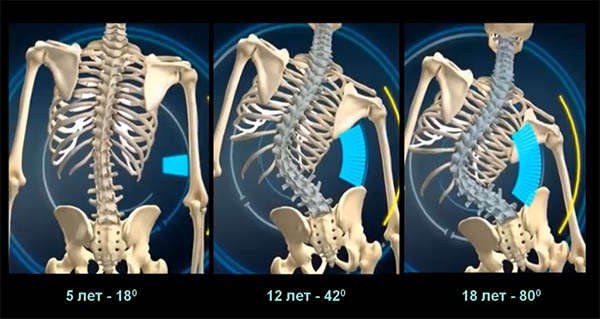
Natural Course of Idiopathic Scoliosis:
- At 7 years old: 18 degrees
- At 10 years old: 32 degrees
- At 12 years old: 40 degrees
- At 13 years old: 62 degrees
- At 14 years old: 74 degrees
- By 30 years old: 90-100 degrees
Conservative treatment for this condition fails to provide positive results in 16% of patients (Fischenko V.Ya., 1973). In cases of progressive scoliosis, it does not stop the further development of the process, let alone correct the deformity.
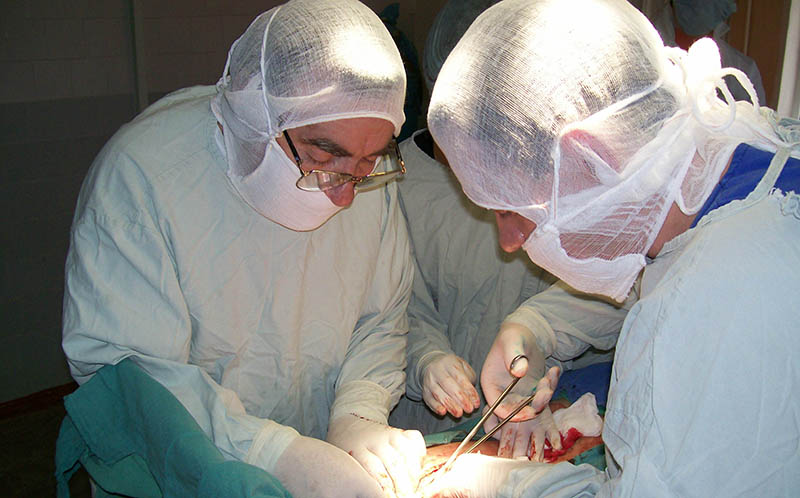
In such cases, surgical treatment of severe forms of scoliosis in children and adolescents becomes necessary, aimed at halting the progression of the deformity, correcting it, and creating more favorable conditions for the functioning of internal organs. The goal is also to eliminate conditions that could lead to irreversible, organic dysfunctions of internal organs and reduce cosmetic defects.
Correction and surgical fixation of the spine are performed when prolonged conservative therapy fails in cases of progressing Grade II scoliosis or Grade III and IV scoliosis.
There are several types of surgical operations:
- Disk surgeries: Discectomy, nucleotomy of disks at the apex of the deformity.
- Vertebral body surgeries: Wedge-shaped resection.
These types of surgeries are combined with posterior bony plastic fixation of the spine: corrective surgeries using modern metal constructs. In the case of a rib hump, resection of the most prominent ribs or thoracoplasty is performed. Depending on the cause of the condition, combined surgical methods are applied, including individual components from the listed techniques.
Approximately six months after surgery, the patient’s life returns to a normal rhythm: they can study, work, travel, and not experience significant discomfort. Of course, the constructs implanted in the spine limit flexibility, but they don’t interfere with self-care, household, and work tasks. In general, life significantly improves after a successful surgery, and for many patients, it improves drastically in a positive direction.
Contraindications for Surgical Treatment of Scoliosis:
- Non-progressing or slowly progressing scoliosis of Grade I and II in patients of any age.
- Severe internal organ changes (heart defects, pathological liver changes, etc.) in weakened or cachectic patients.
- Congenital respiratory and cardiovascular system changes in decompensation stage (Grade 3 heart failure and external respiratory function below 70% of normal for the patient’s age).
- Severe rigid scoliosis of Grade IV with a long history (8-10 years) and no prior treatment.
The indications and contraindications for surgical treatment of scoliosis are outlined broadly, as each patient requires an individual approach considering the specific course of the disease.

