


Conducting a posture test is very simple — you can check your child’s posture yourself without the help of doctors. With this posture test, you can determine whether your child has any significant deviations in the development of their back. For example, spinal curvature (scoliosis, kyphoscoliosis) or the beginning of slouching — kyphosis. Or none at all.
1. PRELIMINARY EXAMINATION
To determine correct posture, first examine the person standing straight from behind and from the side.
- When looking from behind, pay attention to the shoulder blades — they should be symmetrical, at the same distance from the spine, and pressed to the torso.
- The gluteal folds (the folds at the base of the buttocks) should also be symmetrical.
- The waist triangles should also be symmetrical.
You might ask: what are “waist triangles” and how to assess their symmetry? Here’s an explanation: To see and assess the waist triangles, ask the person being examined to freely and relaxedly lower their arms down. This creates a triangular-shaped space between the lowered arms and the contour of the waist — this is the waist triangle. Now compare the size of the triangles on the right and left sides of the body. If the sizes differ, it means the waist triangles are asymmetrical.
If the waist triangles, shoulder blades, and gluteal folds are asymmetrical, this usually indicates some degree of scoliosis — spinal curvature. However, slight asymmetry is noticeable in most people — perfectly symmetrical people, as you know, practically don’t exist.
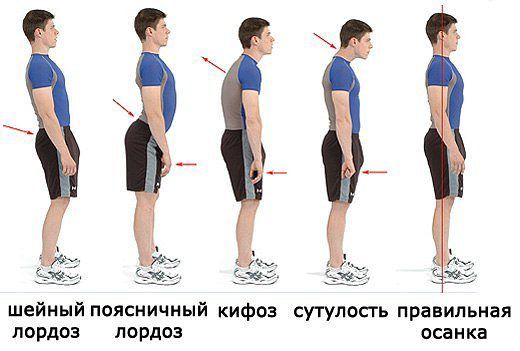
Now examine the person from the side. In a properly developed adult, the chest should be slightly raised, the abdomen pulled in, the legs straight, and the natural curves of the spine smooth and moderately expressed.
In a person with poor posture, you can easily notice an increased thoracic kyphosis (an excessive forward curvature of the upper back). This increase in kyphosis often appears with slouching (and in Scheuermann’s disease). You may also notice an increased lumbar lordosis (excessive inward curvature of the lower back). This often occurs with Scheuermann’s disease or flat-concave back. From the side, it is also easy to see a loss or reduction of spinal curves, characteristic of flat back, as well as in ankylosing spondylitis (Bechterew’s disease) and in old age. In old age, spinal curves usually become less pronounced, flattening out. But about one-third of people experience an increase in thoracic kyphosis, with a severely hunched spine; sometimes an old-age hump may form. This usually happens with osteoporosis — age-related bone density loss.
2. EXAMINATION IN FORWARD BEND
Ask the person to bend forward and try to touch the floor with their hands. Normally, a harmoniously built person should easily touch the floor with their fingertips without bending their knees.
- If a person bends forward without bending the knees and not only touches the floor with their fingertips but easily places their palms flat on the floor, this usually indicates hypermobility of the joints and spine, or that the person spends too much time on stretching exercises — which is not always good.
- Conversely, if the person bends forward without bending the knees but cannot reach the floor with their fingertips by more than 10-15 centimeters, this indicates the opposite extreme — poor physical condition, chronic muscle spasms in the legs and lower back; possibly Scheuermann’s disease (if poor flexibility is combined with noticeable slouching).
- A gap of more than 30-40 centimeters, especially in someone under 45 years old, requires special attention! Combined with constant back pain and noticeably reduced spinal flexibility, this may indicate Forestier’s disease, ankylosing spondylitis (Bechterew’s disease), or a severe form of Scheuermann’s disease.
After determining the distance between the floor and the fingertips, examine the person’s back while they remain bent forward. You can easily detect curvature in any part of the spine (if present) to the right or left. Also, it is easy to notice if one shoulder blade sticks out more than the other. These are all signs of scoliosis. When bending forward, you can also detect pelvic tilt — when one iliac crest is positioned higher than the other. Such a tilt indicates either significant shortening of one leg or, again, scoliosis.
3. FINAL STAGE – EXAMINATION AGAINST THE WALL
At this stage, ask the person to stand with their back against the wall, arms relaxed at their sides, and press their heels, buttocks, and the back of their head against the wall. Their feet should be together; spreading the feet is not recommended.
A properly built person will have no difficulty passing this test. But a person accustomed to slouching, especially one with Scheuermann’s disease, will find it difficult to press the back of their head against the wall without lifting either the heels or buttocks off the wall. It will be even harder if you also ask them to press their shoulders against the wall. For a slouching person, this will be extremely difficult!
The difficulty in pressing the shoulders and back of the head against the wall indicates a habit of constant slouching, or excessive kyphosis, or Scheuermann’s disease.
Finally, pay attention to the distance between the lower back and the wall during this test. Normally, the lower back should allow only a palm to barely fit flat between it and the wall. If the gap is large, so that the palm fits easily and there is still space, it indicates excessive lumbar lordosis — common in Scheuermann’s disease or flat-concave back.

