


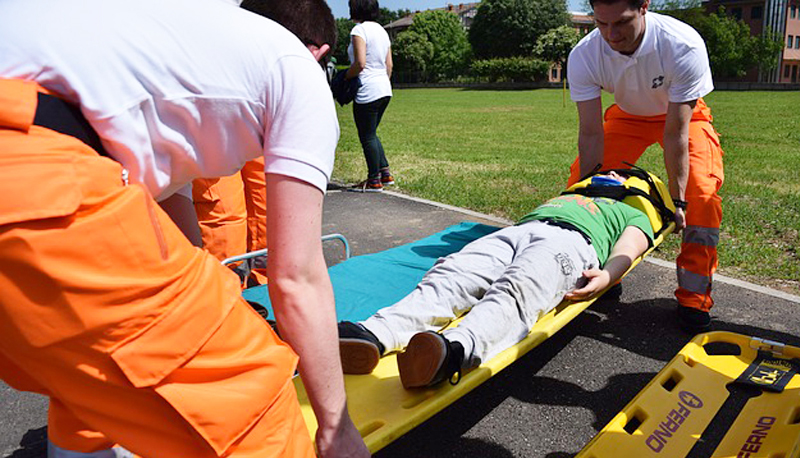
The spine, acting as the body’s main “longitudinal support beam,” bears the primary load during falls from great heights, collapses, and road traffic accidents.
In elderly people, spinal injuries can result even from minor impacts due to age-related bone fragility and loss of elasticity—for example, a fall on an icy sidewalk.
People who sustain such injuries may be in traumatic shock: they appear pale, weak, sluggish, and indifferent. They often do not even complain of pain in the spine area.
A fracture often reveals itself through paralysis of the arms and legs caused by spinal cord injury. Breathing and heart function may also be impaired. If the injury occurs at the lumbar level, not only paralysis of the legs but also loss of control over pelvic organs can occur; the injured person may have no urge to urinate.
In elderly patients, spinal fractures are also not always accompanied by severe pain. The only complaint may be increased pain during movement or bending. Therefore, even if a person feels fine, standing, walking, or sitting after such an injury is dangerous: bone fragments can damage the spinal cord.
The injured person should be carefully extracted from a crushed car, under fallen slabs, or trapped beneath trees. Ideally, three helpers should assist: one supporting the head and shoulder blades, the second supporting the lower back and pelvis, and the third supporting the legs.
The injured person must not be carried by hand or on a blanket! This can worsen their condition.
They should be transported lying on their back on a rigid stretcher. A thick, non-bending board at least 50–60 cm wide and slightly longer than the person’s height will do. You can remove a door from its hinges or use a sheet of thick plywood. Tied-together skis, rails, or narrow boards are less reliable.
It is also acceptable to place the injured person on a stretcher made from two poles, 2.5 meters long and at least 10 cm in diameter. Thread the poles through the inside-out sleeves of a coat or two jackets buttoned together. Place rolled-up clothing, hay, or branches under the suspected spinal fracture area.
The injured must be securely fastened to the stretcher. For this, 9–10 strong ties about 150–200 cm long are needed. These can be made from towels, fabric strips, or belts. Bind the person’s legs together and fix them at the ankle joints, middle of the lower leg, knee joints, mid-thigh, groin level, then pelvis, waist, chest, and figure-eight style around the shoulder joints. Tie the knots on top, neither too tight nor too loose, to prevent shifting during movement.
If the person is in traumatic shock, the best option is to wait for the ambulance to arrive at the scene. If this is impossible (for example, if the injury occurred high in the mountains, in a cave, or a mine), they must be transported even in shock. However, do not rush or move too quickly over rough terrain, as this may worsen the patient’s condition. Do not give them anything to drink; if vomiting starts, ensure they do not choke on the vomit.
It is strictly prohibited to:
- Sit the patient up
- Put them on their feet
- Pull on their legs or arms
- Attempt to realign cervical or any other vertebrae by yourself
- Give medication to a patient with impaired swallowing or loss of consciousness
- Transport the patient to the hospital while sitting
Call emergency medical services to hospitalize the injured person in a trauma center or an emergency facility with a neurosurgery department.
Proper and timely first aid for spinal injuries can preserve a person’s motor function and significantly reduce rehabilitation time.
We hope everything will be fine for you, and that our theoretical material will remain just theory for your entire life! Stay healthy and successful!

