


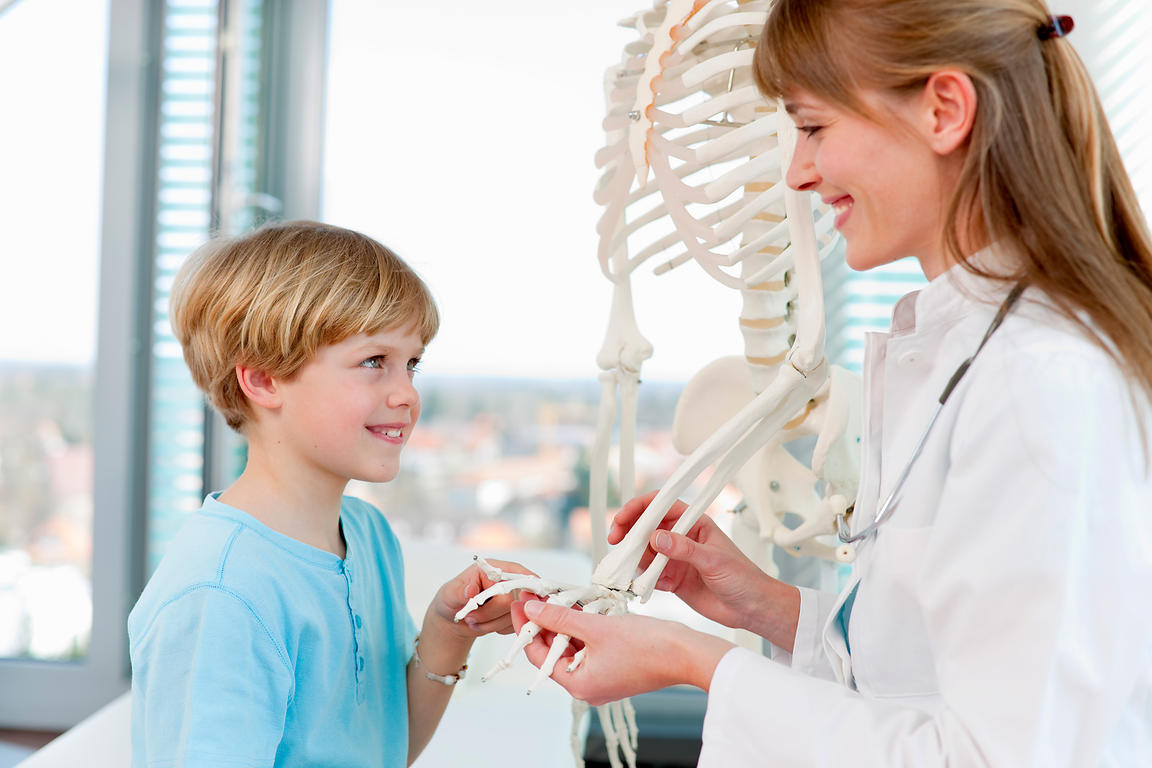
Qualified medical care for orthopedic pathologies, joint diseases, musculoskeletal injuries, and their consequences. We are always happy to help you!
We want every child to have as few reasons as possible to visit medical offices, but even a healthy baby needs to see specialists from time to time. Since a baby’s body develops rapidly after birth, it’s important to monitor the formation of all body systems, including the skeletal system. The orthopedic specialist’s task is to timely diagnose and treat congenital and acquired disorders of the musculoskeletal system. During the first year of life, the orthopedist mainly focuses on diagnosing and treating congenital disorders.

The first scheduled meeting between the child and the orthopedist usually takes place at 1 month of age, provided that no obvious problems requiring urgent attention were detected earlier in the maternity hospital or during a home visit by the family doctor. At this stage, the specialist’s task is to determine whether the child has any congenital conditions such as dislocations, clubfoot, torticollis, or developmental dysplasia of the hip joints. Most of these defects, when detected early, respond well to non-surgical correction. If treatment is started in time, the child’s skeleton will develop correctly and function fully in the future.
Even if parents do not notice any abnormalities in their child, a professional assessment is necessary. For example, the aforementioned developmental dysplasia of the hip joints cannot be diagnosed without a specialist’s help, but missing this can lead to serious consequences. An advanced form of the pathology may cause pain, gait disturbances, and even disability. However, if dysplasia is diagnosed within the first 3 months of life, correction will take no more than a few months, and the child will be freed from this problem forever and without any consequences.
During the first year of a child’s life, they need to visit an orthopedist at least 4 times — at 1 month, 3 months, 6 months, and 1 year.
Besides detecting congenital pathologies, the specialist’s task is to monitor the development of the musculoskeletal system, observe changes in the skeleton as the baby begins to roll over onto their tummy, sit, and stand. During these check-ups, the orthopedist also looks for signs of rickets — a disease related to vitamin D deficiency.
Parents should prepare in advance for the meeting with the orthopedist and think about which questions to ask.
Don’t expect the doctor, especially if there is a queue outside the door, to explain everything in detail without prompting. Be proactive and show interest. Worried about the shape of your baby’s legs? Ask about it. Notice the baby always turns to one side? Consult if this could indicate a problem. Ask which exercises are recommended at home, whether massage might be useful, how to choose proper shoes for your child’s feet, if you should buy jumpers or walkers, etc. Before the consultation and receiving the doctor’s recommendations and prescriptions, search online about conditions similar to what you suspect. You should understand what the conversation will be about, what might be happening, and what treatment methods are applicable.
Although most questions arise in the first year, this doesn’t mean orthopedic consultations are unnecessary afterward.
In the future, yearly visits to the orthopedist are desirable, along with additional consultations if you decide to enroll your child in a sports section or notice your first-grader sitting crookedly at their desk.
Frequent prolonged sitting, standing in uncomfortable positions, or carrying heavy loads can alter the shape of the feet or spine and lead to flat feet, scoliosis, and other deformities.
Uneven muscle development further contributes to pathology.
The deep back muscles that support proper spinal alignment are still insufficiently strong at ages 6-7. This causes the child to slouch, and poor posture becomes habitual.
The musculoskeletal system undergoes heavy strain during puberty, between ages 11-14.
Under hormonal influence, the skeleton rapidly changes: bones lengthen, but muscle mass grows much more slowly. As a result, there is a risk of lordosis, kyphosis, and other pathologies.
Problems with the spine and joints are never isolated.
They always represent a tangle of interconnected processes that constantly interact, influencing each other with diverse manifestations and symptoms. The danger of musculoskeletal diseases lies in improper skeletal formation, which disrupts the positioning of internal organs relative to one another, causing compression and poor nutrition.
For example, flat feet increase the load on the knee and hip joints, making them more vulnerable to injury and faster wear.
With spinal curvature, the volume of the chest and abdominal cavity decreases, worsening the nutrition of the spinal cord and brain. Associated symptoms may develop: frequent headaches, reduced concentration and attention, and even diminished hearing and vision. Therefore, timely diagnosis and treatment of musculoskeletal diseases are so important.
Remember, problems don’t arise without reason.
They do not develop in one day or even in one year. The groundwork is laid over a long time. Solving your health issue is often neither simple nor quick. Many musculoskeletal diseases respond well to treatment if caught early. Regular exercises and strict adherence to orthopedic recommendations can fully eliminate disorders or significantly compensate for them.
Unscheduled visits to the pediatric orthopedist are necessary if the following symptoms are observed:
- Asymmetrical skin folds on the arms and thighs in children under 1 year old;
- Delayed physical development: the child turns over, sits, or starts walking late and with difficulty;
- Limited movement in the hip joint — noticeable when changing diapers or clothes, the child’s legs don’t “open up” properly;
- Unequal length of upper or lower limbs.
For children aged 3 and older, signs of musculoskeletal system dysfunction include:
- Heavy, uneven gait; the child has difficulty standing, constantly grabs onto supports (wall, chair);
- Clubfoot: improper foot positioning when walking;
- Noticeable slouching or leaning to one side while walking or sitting;
- Visible changes in the joints: swelling, lumps, redness, rash, or bluish skin;
- Complaints of muscle or joint pain;
- Physical weakness, manifested as poor coordination during active play or frequent dropping of objects;
- Forced head position;
- Numbness or unusual sensations in limbs (tingling, “pins and needles”);
- Localized increased body temperature;
- Past injuries: severe bruises, dislocations, fractures, ligament tears.
Children often visit pediatric orthopedists for injuries such as bone fractures, dislocations, ligament and tendon tears. Symptoms include:
- Limited mobility of the injured limb or joint. Movement attempts cause sharp pain;
- Changes in skin color at the injury site — redness or bruising, often with hematoma formation;
- Swelling and edema in the affected area, sometimes with localized increased temperature.

